
Hengrui Environmental Technology Co., Ltd.
Introduction to Wind Turbine
A fan is a mechanical device that converts mechanical energy into gas pressure energy and kinetic energy, and is widely used in various fields. Here is an introduction to the fan:
1、 Working principle
The fan mainly relies on the rotation of the impeller to generate airflow. When the impeller rotates, the blades push air or other gases to gain energy, thereby generating pressure and velocity. According to different working principles, fans can be divided into centrifugal fans, axial fans, and mixed flow fans.
Centrifugal fan: Gas enters the impeller from the axial direction, and under the high-speed rotation of the impeller, the gas is thrown towards the outer circumference of the impeller, then flows along the volute shaped casing, and finally discharged from the air outlet. Centrifugal fans have high pressure and low flow rate, making them suitable for situations that require high pressure.
Axial flow fan: Gas enters the impeller along the axial direction and flows along the axial direction under the push of the impeller. Axial flow fans have high flow rates and low pressures, making them suitable for situations that require high flow ventilation.
Mixed flow fan: Combining the characteristics of centrifugal and axial fans, the gas has both axial and radial velocities. The performance of mixed flow fans is between centrifugal fans and axial fans.
2、 Structural composition
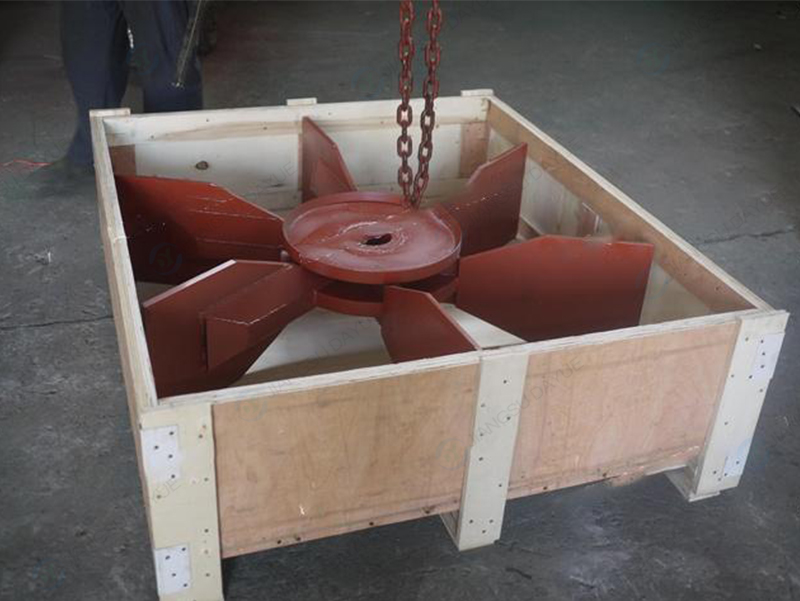
Impeller: It is the core component of a fan, consisting of blades and a hub. The shape and size of the impeller determine the performance and efficiency of the fan.
Shell: Used to accommodate impellers and guide airflow, usually made of metal or non-metal materials. The shape and size of the casing should match the impeller to ensure smooth airflow.
Drive device: including motor, reducer, coupling, etc., providing power for the impeller. The power and speed of the driving device should be selected according to the performance requirements of the fan.
Air inlet and outlet: used to connect the fan with the pipeline system. The shape and size of the air inlet and outlet should be designed according to the flow rate and velocity of the airflow.
Regulating device: used to regulate parameters such as flow rate, pressure, and speed of the fan. Common regulating devices include valves, frequency converters, etc.
3、 Advantages
Large gas delivery capacity: The fan can provide a large amount of gas delivery according to different needs, meeting the ventilation, air exchange, and heat dissipation requirements of various industrial and civilian occasions.
Wide pressure range: Different types of fans can provide different pressure ranges, from low pressure to high pressure, to meet the requirements of different application scenarios.
High reliability: The fan has a relatively simple structure, stable and reliable operation, and low maintenance costs.
Strong adaptability: It can adapt to different gas media, temperature, humidity, and pressure conditions, and is widely used in various harsh environments.
4、 Disadvantages
Loud noise: The fan generates a certain amount of noise during operation, especially at high speeds, which may have an impact on the surrounding environment.
High energy consumption: Wind turbines require a certain amount of electrical energy to drive, especially under high flow and high pressure conditions, resulting in high energy consumption.
High requirements for installation and maintenance: The installation and maintenance of fans require professional technicians to operate, otherwise it may affect the performance and lifespan of the fans.
5、 Application Fields
Ventilation and air exchange: used for ventilation and air exchange in buildings, factories, mines and other places to ensure the circulation and freshness of air.
Air conditioning system: As an important component of the air conditioning system, it is used to transport cold and hot air, regulate indoor temperature and humidity.
Industrial production: used in industries such as chemical, metallurgical, power, and building materials for transporting gases, materials, and ventilation and heat dissipation.
Environmental Protection Engineering: Used in environmental protection projects such as waste gas treatment and flue gas emissions to ensure the cleanliness and safety of the environment.
In the field of agriculture, it is used for greenhouse ventilation, grain drying and other agricultural production processes.
Related Products

.jpg?x-oss-process=image/resize,w_100/quality,q_100)


Contact US
Product Information
Quantity
Unit
Piece
Support order samples, customization, wholesale direct, and complete payment. If the product you look for does not have corresponding customized content, pls fill out the form below to contact us, and we will reply ASAP.