
Hengrui Environmental Technology Co., Ltd.
What is the working principle of a dust collector?
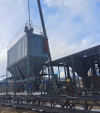
The working principle of industrial dust collectors varies depending on the type, but overall they separate and collect dust particles from dusty gases through certain physical or chemical means to purify the air. The following are the working principles of several common industrial dust collectors:
Mechanical dust collector:
Gravity dust collector: utilizing the effect of gravity to separate dust particles from dusty gases during the settling process. This method is suitable for larger dust particles and has relatively low dust removal efficiency.
Cyclone dust collector: relying on centrifugal force, the dust particles are thrown towards the outer wall due to inertial force during the rotation of the dusty gas, thereby achieving the separation of dust and gas. The cyclone dust collector is suitable for purifying non viscous, non fibrous dry dust larger than 5-10 microns, and has the advantages of simple structure, easy operation, and high temperature resistance.
Inertial dust collector: Utilizing the inertia of dust, by changing the direction of the airflow or causing the dusty gas to collide with the baffle, the dust particles are separated from the gas due to the inertial force. This type of dust collector generally has low dust removal efficiency, but its structure is simple and the resistance is low.
Electric dust collector:
Dust removal is achieved through four stages: gas ionization, dust charging, dust settling, and dust cleaning. Firstly, the electrode undergoes corona discharge, which ionizes the gas and generates a large number of free electrons and positive ions; Then, the dust particles are charged in the electric field, move towards the dust collecting electrode by the force of the electric field, and deposit down; Finally, the deposited dust is removed through a dust cleaning device. Electric dust collectors have the advantages of high dust removal efficiency and suitability for processing high-temperature gases.
Wet dust collector:
Close contact between dusty gases and liquids (usually water), utilizing the inertial collision and other effects of water droplets and particles to capture or enlarge particles, and ultimately being carried away by the water flow. Wet dust collectors have the advantages of high dust removal efficiency and are suitable for treating high humidity and high concentration dust containing gases, but there are problems such as wastewater treatment.
Filter type dust collector (such as bag filter):
When the dusty gas passes through the filter cloth, the dust particles are intercepted by the filter cloth and deposited on the surface of the filter cloth to form a dust layer, while the purified gas is discharged through the filter cloth. As the dust layer on the surface of the filter cloth thickens, the resistance of the filter cloth increases, and the dust layer needs to be removed by a cleaning device. Bag filter has the advantages of high dust removal efficiency and wide applicability, especially suitable for capturing fine dust.
In summary, there are various working principles of industrial dust collectors, but they all achieve the separation and collection of dust and gas through certain physical or chemical means. When selecting a dust collector, it is necessary to choose the appropriate type of dust collector based on specific working conditions and dust removal requirements.
Related News



Contact US
Product Information
Quantity
Unit
Piece
Support order samples, customization, wholesale direct, and complete payment. If the product you look for does not have corresponding customized content, pls fill out the form below to contact us, and we will reply ASAP.